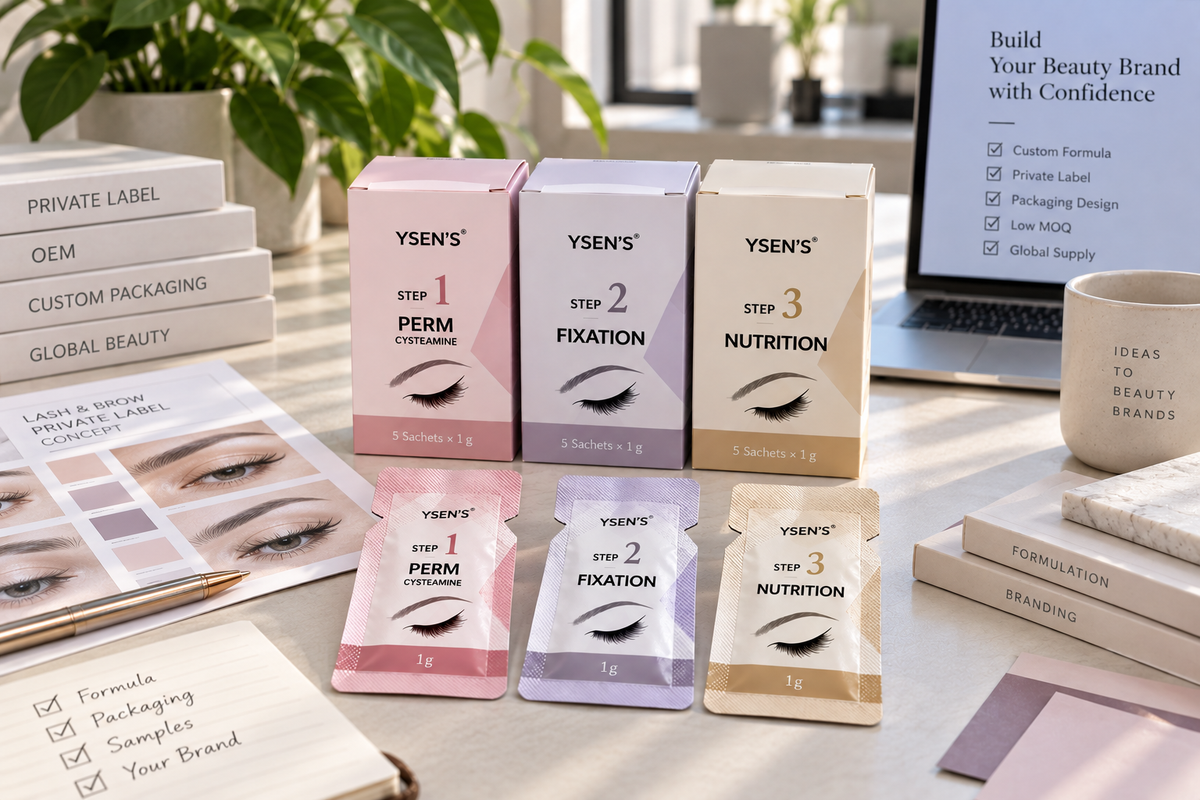
Building a brow product line is not only about choosing a finished product and adding a logo. For beauty brands, academies, distributors, and professional suppliers, the right route depends on how much control you need over the formula, packaging, product range, documentation, and production plan.
This guide explains how to evaluate private label brow products with a focus on brow lamination. It is designed for businesses comparing private label, OEM, and wholesale options before requesting samples or a quotation.
Quick answer
Private label brow products can range from an existing-formula launch to a custom OEM brow lamination project. The right route depends on the formula requirements, packaging format, destination market, estimated quantity, documentation needs, and how much product development the brand requires.
Private label vs OEM brow products
Private label and OEM are often used interchangeably, but they can describe different levels of product development.
Existing-formula private label is generally the more direct route when a brand wants to launch under its own identity using an established product format. Branding and packaging can still be customized according to the project.
Custom OEM development becomes relevant when the project requires changes to the formula, product format, packaging system, or other specifications. Formula modification requires a separate technical review because feasibility, testing, documentation, MOQ, and lead time can change with the requested modification.
YSEN’S supports both existing-formula private label and formula-modification discussions for lash and brow projects. Brands that already know they need brow-specific development can review our Private Label Brow Lamination & OEM options.
What should a brow lamination product line include?
A brow lamination line can be built around a focused professional system rather than a large catalogue. Depending on the target market and brand concept, the project may include:
- Step 1 lifting or perm product
- Step 2 fixation or neutralizing product
- Step 3 care or nourishing product
- Adhesive or glue balm where the treatment protocol requires it
- Professional application and brow-mapping accessories
The right assortment depends on the treatment system you plan to sell, who will use it, and the regulatory requirements of the destination market. A professional-only line may need a different presentation and documentation strategy from a consumer-oriented kit.
Choosing between an existing formula and formula modification
For a first private label launch, an existing formula can reduce the number of development decisions. It allows the brand to focus on positioning, packaging, instructions, and market launch.
Formula modification is more appropriate when the brand has a defined technical brief—for example, a requested texture, application characteristic, ingredient direction, or product format that differs from the existing option. A request to “make it better” is not yet a technical brief; useful development discussions normally start with the desired product behavior, target user, destination market, packaging format, and benchmark.
Brands should also separate formula preference from regulatory claims. A formula that can be manufactured is not automatically approved for every market or every use case.
Packaging: sachets, bottles, and airless pumps
Packaging is part of product development, not only visual branding. Brow lamination products can be considered in formats such as sachets or compatible bottle and pump systems, depending on the formula and project.
Sachets can be practical for portion control and professional treatment workflows. They also make it easier to understand how many unopened portions remain.
Bottles and pump formats can create a different professional presentation and may suit brands that prefer repeated dispensing from one container. Airless pumps can also be considered where technically appropriate, but compatibility with the formula, fill size, dispensing behavior, and visibility of remaining product should be evaluated before a packaging choice is locked.
Packaging selection should therefore happen together with formula and usage review—not after the product has already been finalized.
Packaging color matching in practice
YSEN’S compares printed packaging samples against physical Pantone references during packaging development. Color is reviewed on the actual packaging material because substrate, surface finish and printing can change how a selected color appears.


Real buyer example: when packaging changes the private label brief
In a recent enquiry, a UK beauty business evaluating a private label lash and brow range considered a pump-bottle format instead of relying only on sachets. During the packaging discussion, two practical requirements became clear: the packaging needed to fit the brand’s dark visual direction, while customers also needed to be able to see how much product remained.
That changed the conversation from appearance alone to bottle transparency, pump format, available fill size, formula compatibility, estimated quantity, pricing, and UK market requirements. The project was still at enquiry stage, so commercial terms and the final packaging route had not been confirmed.
Buyer takeaway: choose packaging as part of the product brief. A bottle that fits the brand visually still needs to work with the formula, dispensing method, target market, and commercial quantities.
How MOQ works for private label brow products
There is no useful single MOQ that applies to every brow private label project. MOQ can vary by product, formula route, packaging component, decoration method, and whether the project uses an existing option or requires new development.
A simple logo or label project is different from custom printed packaging, a formula modification, or a completely new component. For that reason, YSEN’S confirms MOQ at the product and project level after reviewing the brief rather than publishing one number for every buyer.
When requesting a quotation, it helps to provide an estimated quantity even if the final order has not been decided. A range is enough for an initial discussion.
How to evaluate samples before placing a production order
Samples are most useful when the buyer evaluates them against a defined checklist. For brow lamination products, that can include product handling, texture, application workflow, packaging usability, compatibility with the intended professional protocol, and the overall experience of the proposed system.
If packaging is part of the project, evaluate the dispensing method as well as the appearance. A visually attractive pump that does not dispense the selected formula consistently is not a successful packaging solution.
Sample availability, sample lead time, and the exact sample configuration should be confirmed for the individual project.
Documents and market requirements
Documentation requirements depend on the product, formula, destination market, responsible party, and intended use. Buyers should clarify these requirements before production rather than treating compliance as a final packaging step.
Depending on the project, relevant documentation can include items such as SDS/MSDS, COA, CPSR and other market-specific cosmetic documentation. EU/UK notification and product-information obligations, and US cosmetic requirements, are separate regulatory questions and should be assessed for the actual product and market.
YSEN’S can support documentation discussions including SDS/MSDS, COA, CPSR, CPNP/SCPN-related projects, FDA/MoCRA-related requirements, and GMP documentation where applicable to the project. The availability of a document does not by itself mean that a finished product is automatically compliant or registered in every market.
Brow lamination wholesale vs private label
Wholesale is appropriate when the buyer wants to purchase existing branded professional products for resale or distribution. Private label is the better route when the buyer wants products presented under its own brand. Custom OEM goes further when product development or specification changes are required.
If your goal is resale rather than creating a new brand, see the YSEN’S Wholesale & Distribution Program. If you are building a branded brow lamination line, the private label route is the more relevant starting point.
Questions to prepare before contacting a manufacturer
A useful first brief does not need to be complicated. Prepare the destination country, the products you want to launch, whether you prefer an existing formula or want to discuss modification, your packaging preference, and an estimated quantity or quantity range.
If you are developing several lash and brow products together, it can also be more efficient to plan them as one range. See our Complete Private Label Lash & Brow Line for multi-product projects.
Private label brow product FAQs
Can I private label an existing brow lamination formula?
Yes. Existing-formula private label can be considered when a brand wants to launch under its own identity without starting with a formula-modification project. Branding, packaging, MOQ, samples, and the commercial route are confirmed for the specific product and project.
Can the brow lamination formula be modified?
Formula modification can be discussed when the brand has a defined development brief. Feasibility, testing, documentation, packaging compatibility, MOQ, and lead time need to be reviewed for the requested modification before production terms are confirmed.
What determines MOQ for private label brow products?
MOQ depends on the product, formula route, packaging components, decoration method, and customization scope. An existing-formula label project and a custom OEM development project do not necessarily have the same MOQ, so YSEN’S confirms it at project level.
What should I send before requesting samples or a quote?
Share the destination market, product family, whether you prefer an existing formula or formula modification, your packaging preference, and an estimated quantity or range. These details help determine the appropriate sample, quotation, and development route.
Planning a brow lamination brand?
Tell us your target market, formula route, packaging preference, and estimated quantity so we can review the appropriate private label or OEM project path.
Start a brow lamination private label project
YSEN’S works with beauty brands, professional suppliers, academies, and distributors on private label and OEM lash and brow projects. The right commercial and technical route depends on the product family and customization scope.
For a brow-focused project, visit Private Label Brow Lamination & OEM and submit your product interest, project type, destination market, and estimated quantity. For a broader overview of available development routes, visit the YSEN’S Private Label & OEM hub.

Commenta
Questo sito è protetto da hCaptcha e applica le Norme sulla privacy e i Termini di servizio di hCaptcha.